
Never miss an offer or update. You can unsubscribe at any time.
For mechanical engineers and building automation specifiers, achieving perfect indoor climate control while adhering to strict energy regulations is a constant balancing act. In high-end commercial HVAC control systems, traditional on/off relay controls simply cannot meet the precise thermal demands of modern infrastructure. The industry standard has definitively shifted toward proportional control, making the 0-10V thermostat a mandatory component for maximizing Fan Coil Unit (FCU) efficiency.

To understand the value of a modulating fan coil thermostat, we must first look at the limitations of legacy systems.
Traditional 3-speed thermostats operate on a simple binary logic. When the room temperature deviates from the setpoint, the thermostat opens the valve 100% and blasts the fan at a fixed speed. Once the target is reached, it shuts off completely. This creates noticeable temperature fluctuations (the "yo-yo" effect), excessive mechanical wear, and high acoustic noise each time the fan kicks in.
A 0-10V modulating thermostat utilizes advanced PID (Proportional-Integral-Derivative) algorithms. Instead of sending a rigid on/off command, it outputs a continuous analog voltage signal ranging from 0 to 10 volts. If the room needs just a little cooling, the thermostat might output a 3V signal, slightly opening the valve and running the fan at a whisper-quiet low speed. This results in a flat, perfectly stable temperature curve.
The true power of this protocol lies in its ability to directly communicate with the mechanical endpoints of the FCU via dedicated analog outputs.
Electronically Commutated (EC) motors are the gold standard for modern HVAC fans. Unlike AC motors stuck with three fixed speeds, an EC motor thermostat uses the 0-10V signal (typically wired to AO1) to provide stepless, variable fan speed control (from 0% to 100%). This drastically reduces energy consumption—operating a fan at 50% speed consumes only about 12.5% of the power required at 100% speed, adhering to the fan affinity laws.
Similarly, a secondary 0-10V signal (AO2) controls proportional actuators on chilled or hot water valves. By regulating the exact flow of water through the coil based on real-time thermal demand, the system eliminates "water hammer" issues in the piping and prevents the over-cooling or over-heating associated with standard thermal actuators.
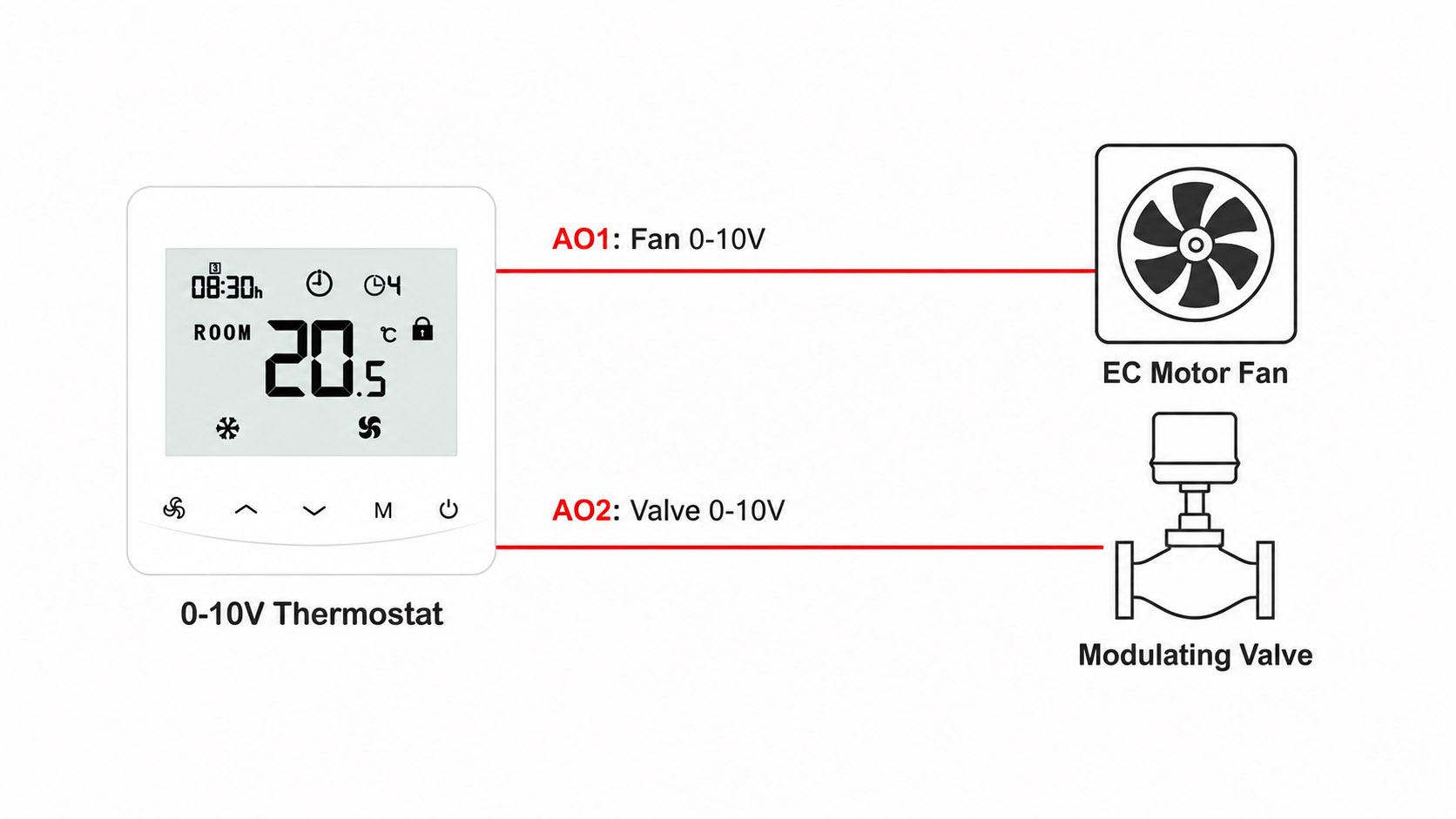
In premium architectural projects, 0-10V control is no longer optional; it is written into the engineering specifications for several critical reasons:
As a leading ISO-certified manufacturer, E-TOP Controls designs high-precision modulating thermostats compatible with major EC motor and valve brands. Connect with our R&D team for OEM solutions and BMS integration.
Inquire NowUpgrading to a 0-10V system requires ensuring your Fan Coil Unit is equipped with an Electronically Commutated (EC) motor and a proportional valve actuator. Standard AC motors and thermal on/off valves cannot interpret 0-10V analog signals directly. Once the mechanical endpoints are compatible, E-TOP offers versatile 0-10V thermostats that seamlessly drive these highly efficient components for commercial retrofits.
Unlike standard On/Off controls that cause temperature swings and mechanical wear, a 0-10V modulating thermostat provides a continuous analog signal for stepless adjustment of fan speeds and water valves. This precision ensures whisper-quiet operation, exact temperature stability, and compliance with stringent commercial energy standards (like LEED certification).
Yes. E-TOP's modulating FCU thermostats can be customized with built-in RS485 communication ports, supporting standard Modbus RTU or BACnet MS/TP protocols. This allows facility managers and system integrators to seamlessly connect room-level 0-10V controls into centralized Building Management Systems.
 Address:No.6 of Tong'an Industrial Park, Meixi Rd,Tong'an District, Xiamen China 361100
 Phone:+86 0592 6155792
 Email:[email protected]