
Never miss an offer or update. You can unsubscribe at any time.
To guarantee the highest level of comfort and efficiency, E-TOP Controls has invested in a state-of-the-art environmental simulation laboratory. We do not just test circuit boards; we simulate real-world thermal dynamics to verify that our HVAC algorithms perform flawlessly under extreme winter conditions.
The E-TOP climate lab features a highly insulated testing chamber capable of dropping ambient temperatures to -20°C, perfectly replicating the harsh winters of Northern Europe. Inside this freezing chamber sits a specially constructed full-scale wooden house. By installing our smart thermostats inside this structure, we can truly restore the heating conditions of actual users and analyze thermodynamic heat transfer in real time.
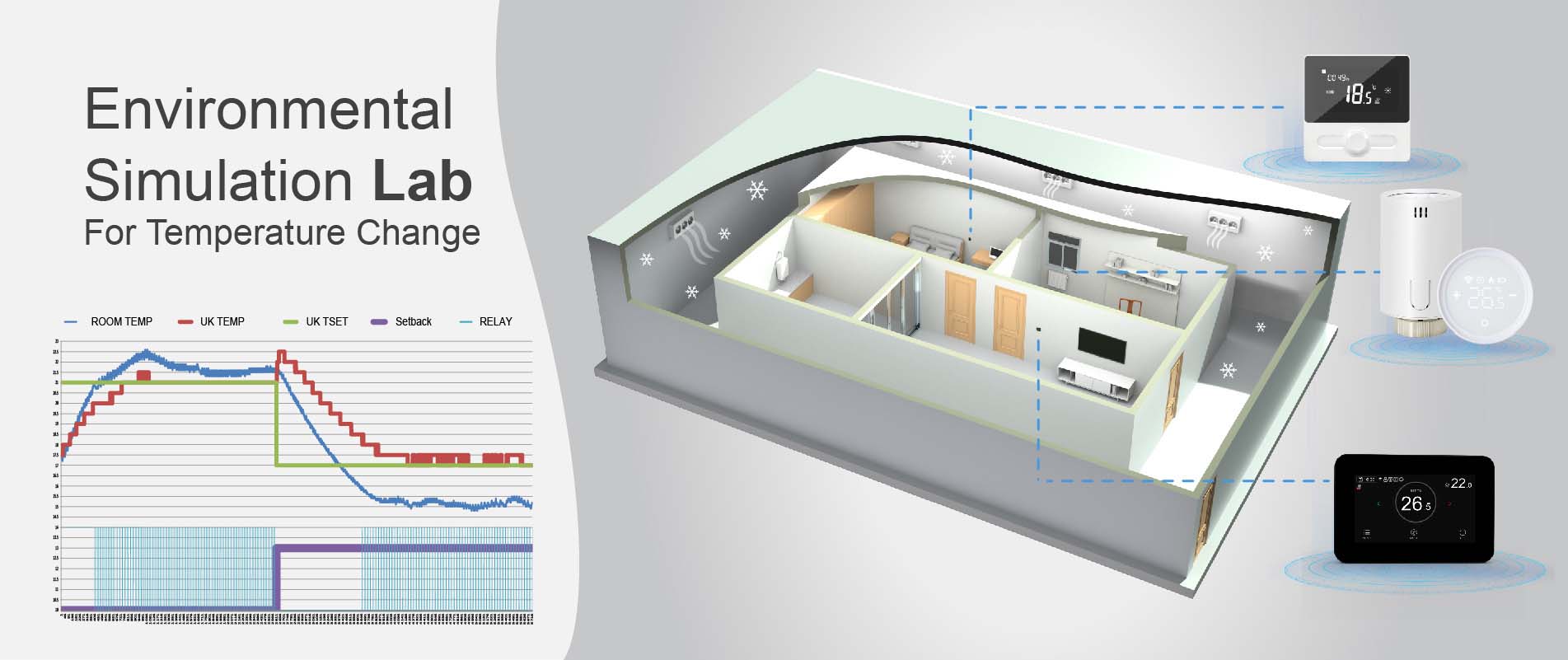
Our highly insulated environmental chamber simulating extreme -20°C winter conditions.
Equipped with four high-power industrial refrigerators, the outer chamber drives temperatures down to -20°C. Our engineers can program dynamic temperature curves to simulate the natural shift from freezing nights to warmer days, testing how quickly the thermostat reacts to sudden environmental changes.
Built inside the freezing chamber, this structure features three rooms and two halls. It utilizes 180mm-210mm thick walls made of wooden keels, thermal insulation, and soundproofing materials. Strategically placed thermocouple devices monitor the precise temperature gradients across the walls and floors.
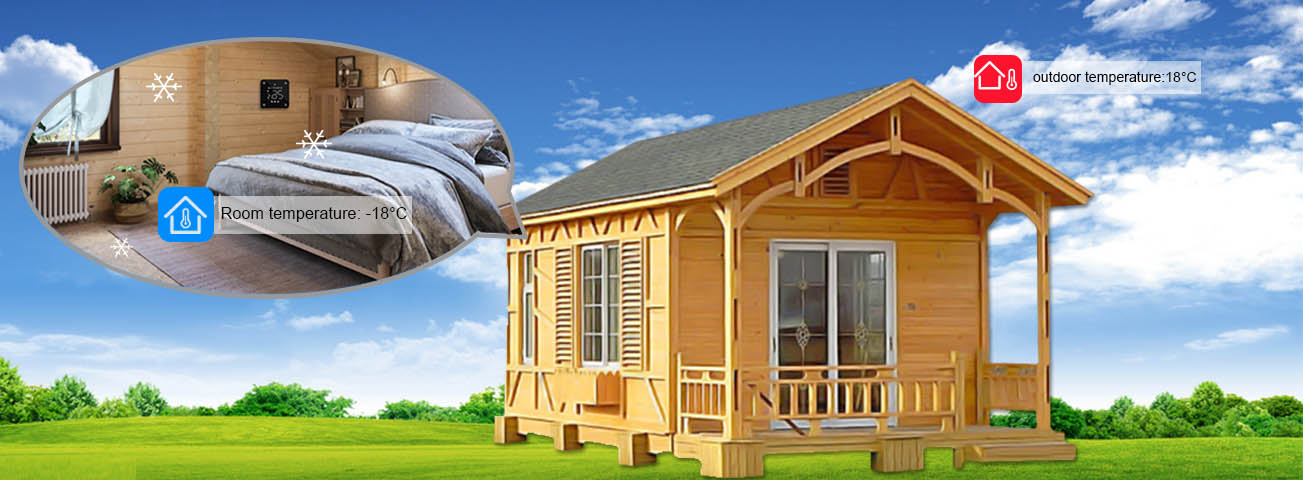
The internal residential structure equipped with multi-point thermocouple sensors.
We test both Underfloor Water Heating (50-60°C water transferring heat homogeneously through the floor) and Radiator Systems (70°C water driving convection and thermal radiation). This dual-setup ensures our algorithms are perfectly tuned for any European heating configuration.
All thermal data collected by the sensors is transmitted to our central monitoring system in real time. Unlike legacy thermostats that rely on crude relay switching (providing only 0% or 100% power, causing uncomfortable temperature fluctuations), our lab focuses on advanced continuous modulation.
This real-time feedback is crucial for refining our PID & PWM control logic. Operating on a fixed time cycle, the PID algorithm dynamically adjusts the active high-level duty cycle (PWM) based on temperature gaps. This achieves a smooth, variable-like average power output, completely eliminating thermal overshoot and ensuring constant, precise temperature control.
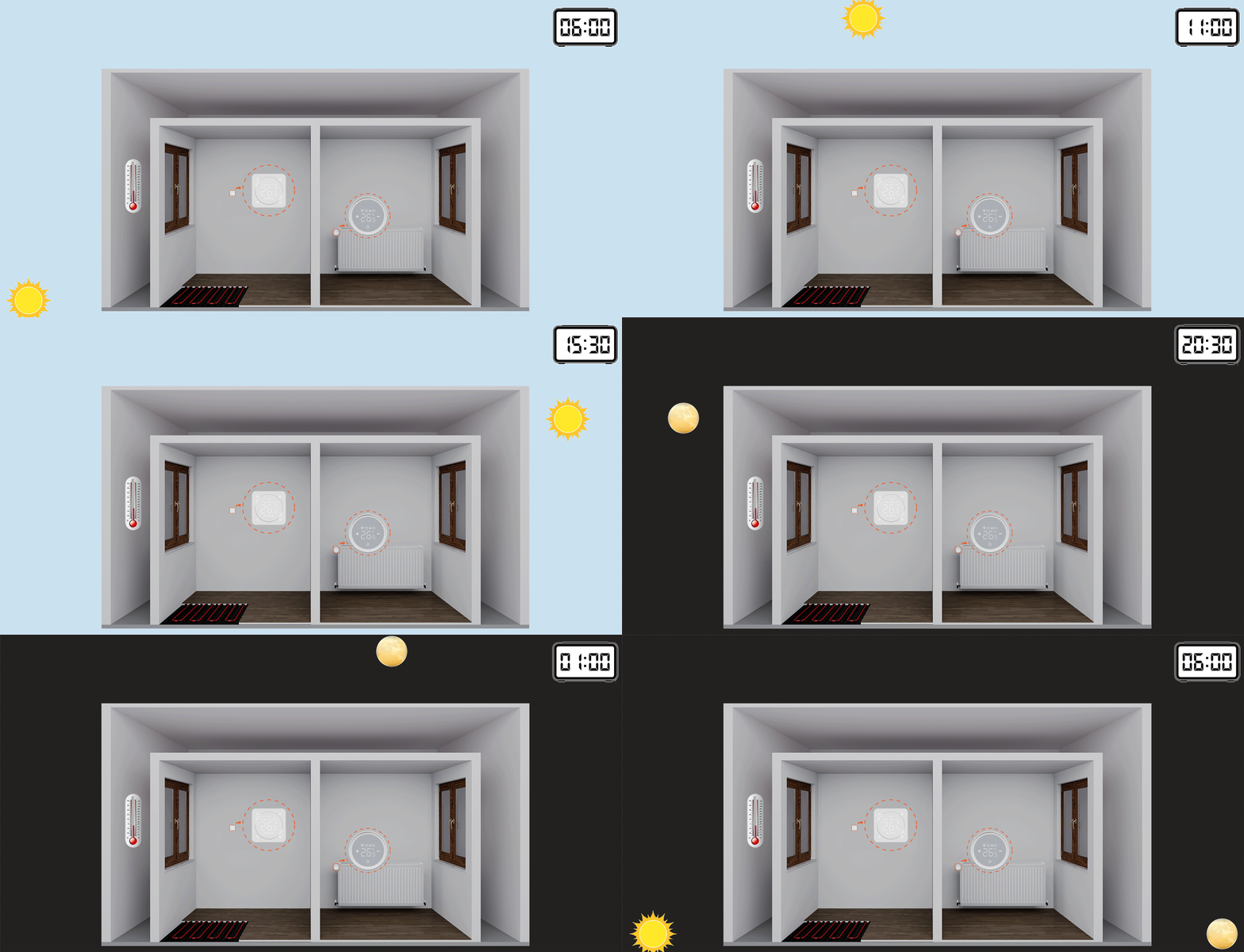
Thermodynamic data processing and real-time environment simulation loop.
Our rigorous climate lab testing guarantees that every unit we manufacture meets the highest European comfort standards. Explore our full range of HVAC Thermostats & Controls or discover our custom R&D capabilities through our Thermostat OEM & ODM Solutions.
Request a QuoteA: Real-world thermal inertia behaves differently than simple bench testing. By dropping ambient temperatures to -20°C, we can evaluate how accurately our thermostats compensate for sudden heat loss and prevent pipes from freezing during harsh winters.
A: Yes. The thermal dynamics of 50°C underfloor heating are entirely different from 70°C rapid convection radiators. Our lab is equipped with both systems, allowing us to customize the PID algorithm specifically for the type of heating element our OEM clients use.
A: Multi-point thermocouple sensors installed across the walls, floors, and rooms feed real-time thermal data back through secure communication lines to our central monitoring system, ensuring precise performance logging for product research.
A: Absolutely. For our strategic B2B partners developing custom smart thermostat solutions, our R&D engineering team can utilize our simulation lab to validate special firmware logic and regional compliance requirements prior to mass production.
 Address:No.6 of Tong'an Industrial Park, Meixi Rd,Tong'an District, Xiamen China 361100
 Phone:+86 0592 6155792
 Email:[email protected]