
Never miss an offer or update. You can unsubscribe at any time.
Upgrading the climate control systems in historical buildings or fully occupied commercial spaces presents a unique engineering challenge. While new constructions can easily route miles of communication cables, retrofitting existing structures often makes traditional wired Building Management Systems (BMS) prohibitively expensive. For contractors and facility managers, the demand for non-destructive commercial HVAC control is soaring. Today, advanced wireless commercial FCU thermostats and smart gateways have emerged as the premier BMS upgrade solutions for legacy Fan Coil Unit (FCU) systems.
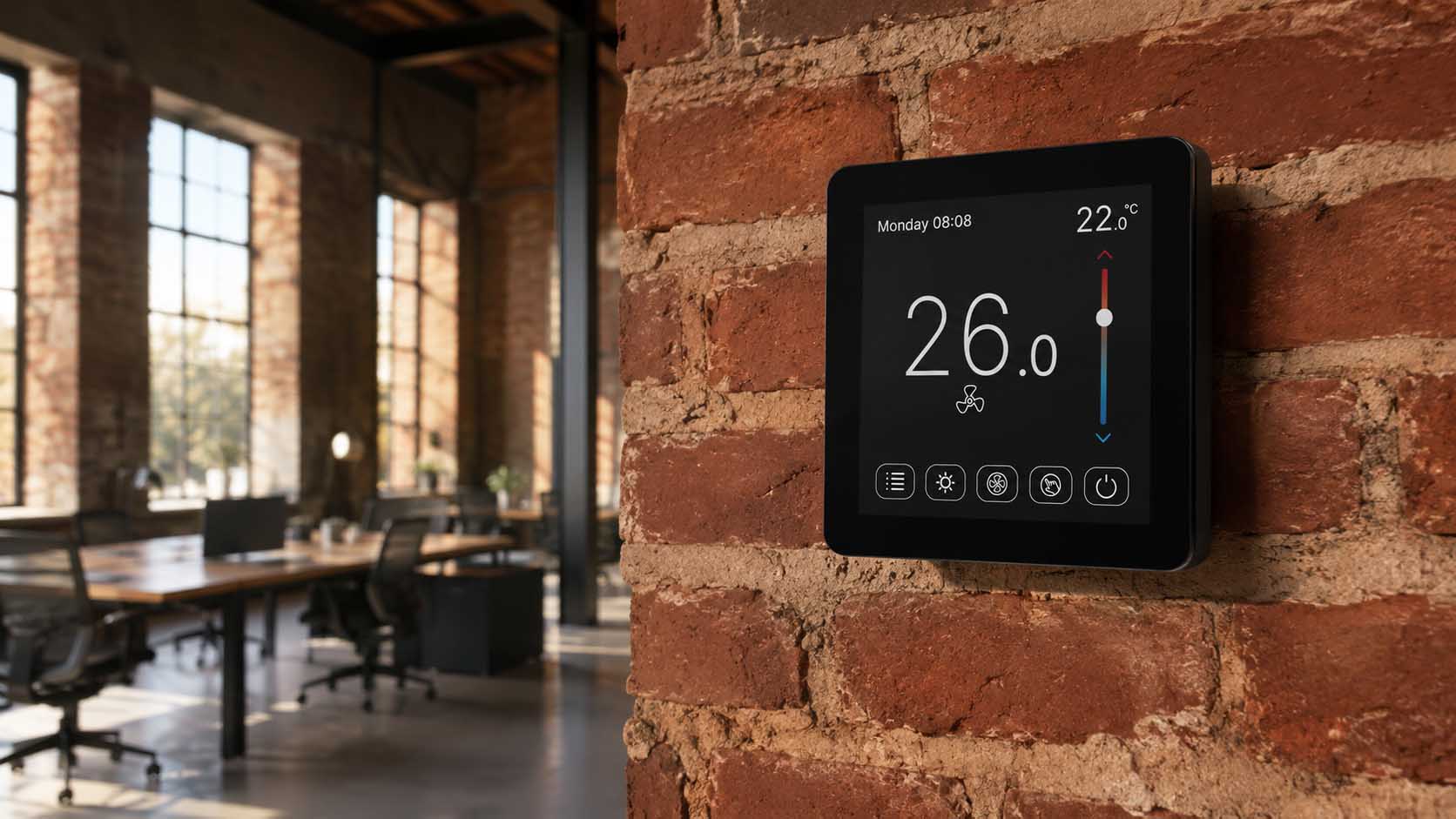
Most of the budget in commercial HVAC retrofit controls doesn't actually go to the hardware itself. It gets eaten up by labor and building tear-downs. Trying to force a hardwired MS/TP or IP network into a legacy space usually means facing a few ugly realities:
This is exactly why wireless commercial thermostats have become the go-to workaround. You skip the physical wire-pulling entirely. Instead, the wall units handle the communication over Zigbee, WiFi, or RF bands.
The cleanest way to handle a retrofit is to wire a compact RF receiver straight into the actual FCU equipment hiding up in the ceiling. Once that's hooked up, you just mount the wireless thermostat on the wall wherever it looks best. You can power the wall unit with batteries or tap into old low-voltage lines. The link between the wall and the machine is totally invisible.
Contractors used to avoid wireless setups because early versions dropped signals constantly. That's changed. With modern protocols like Zigbee, you get a self-healing mesh network. Every single thermostat on the wall acts as a signal booster. The more devices you install, the stronger the network gets, easily pushing data through heavy concrete floors and elevator shafts.
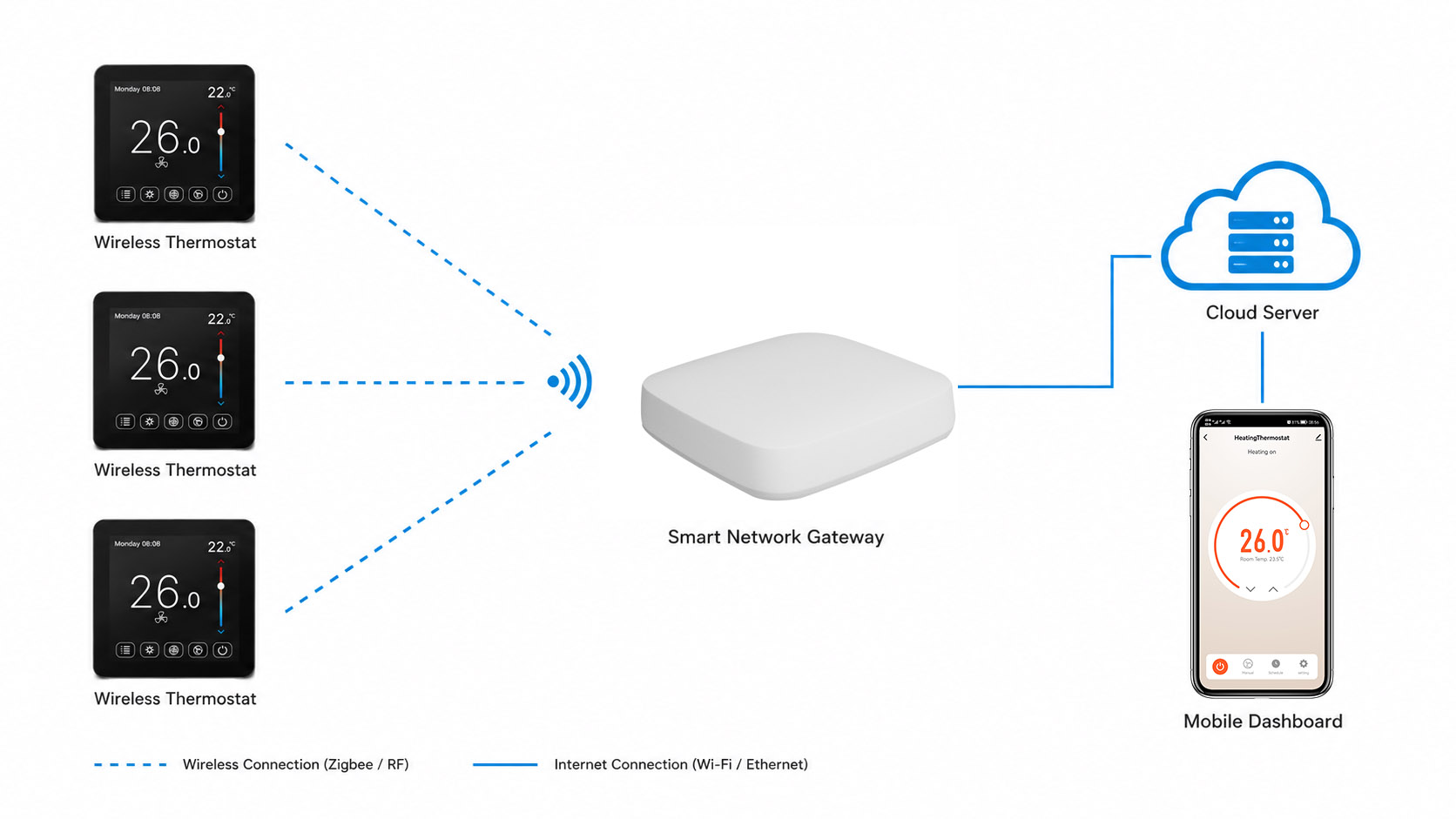
A collection of standalone wireless thermostats is great for individual rooms, but facility managers ultimately want centralized control. That's where the Smart HVAC Gateway comes into play.
You plug one hub into the building's internet router. That hub talks wirelessly to fifty or a hundred thermostats scattered across different floors, gathering all their data and kicking it up to a secure cloud server. What you end up with is a "lightweight BMS." The building manager can sit at a laptop (or pull out a phone), check room temps in real-time, lock out guests from messing with the settings, and adjust schedules globally. It delivers the functionality of a massive wired BMS, but for pennies on the dollar.
As a specialized OEM/ODM manufacturer, E-TOP Controls designs highly reliable wireless thermostats, RF receivers, and smart gateways specifically engineered for commercial retrofits. Elevate your HVAC brand with our scalable wireless BMS alternatives.
Request OEM SolutionsYes. Modern commercial systems use Zigbee mesh networking. Unlike traditional point-to-point WiFi, each Zigbee thermostat acts as a signal repeater. As you add more thermostats to different floors and rooms, the wireless network actually becomes stronger and more resilient, easily bypassing structural interference.
No. The core advantage of retrofit controls is their backward compatibility. You can retain your existing fan coil units or heat pumps. By installing a wireless RF receiver module directly at the equipment's electrical panel, it can instantly communicate with modern wireless wall thermostats without requiring new HVAC machinery.
Depending on the manufacturer and the specific protocol (Zigbee 3.0, for example), a single commercial-grade gateway can typically support between 50 to 100 wireless thermostats. For larger commercial facilities, multiple gateways can be deployed on the same IP network and managed via a unified cloud dashboard.
 Address:No.6 of Tong'an Industrial Park, Meixi Rd,Tong'an District, Xiamen China 361100
 Phone:+86 0592 6155792
 Email:[email protected]