
Never miss an offer or update. You can unsubscribe at any time.
Bridging the Automation Gap: The Future of Commercial HVAC Control in 2026
Managing commercial properties is getting harder every year. Power costs aren't dropping anytime soon, and strict indoor air quality rules are forcing hands. Plus, the pressure to hit carbon-neutral targets is very real. Property owners basically have to rip up their old climate control playbooks and start over. But there is a major hurdle blocking the way: a growing issue known as the automation gap.
This gap happens when a building has outgrown basic residential thermostats, yet the owners cannot afford the massive price tag of a full-scale Building Management System (BMS). Today, we are going to look at the latest trends in Commercial HVAC Control and see how networked commercial thermostats are bridging this divide.
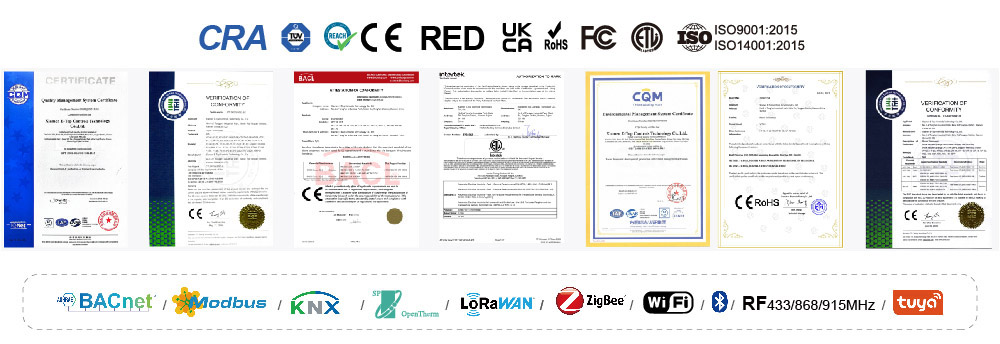
Big building automation historically meant spending massive budgets. There wasn't much middle ground. That's changing fast, though. The market is shifting toward scalable, networked platforms. Instead of pulling miles of wire from individual VAV boxes back to a server room, contractors are dropping in smart, commercial-grade units. These communicate natively using BACnet MS/TP, Modbus RTU, or KNX.
For European sites in particular, KNX is a huge advantage because it pulls HVAC, lighting, and shading into one ecosystem. You can picture these devices as independent mini-controllers scattered around the property. Facility teams get to monitor the entire energy footprint on a single dashboard, achieving most BMS benefits without the crippling costs.
Trying to run fresh comms wire through 40-year-old concrete or asbestos-lined ceilings? It's expensive and risky. Thankfully, wireless technology has caught up to commercial demands. Modern HVAC control setups now lean heavily on robust sub-GHz RF mesh networks, KNX RF, LoRaWAN, and BACnet wireless gateways.
Contractors can utilize self-contained wireless thermostats and remote actuators to overhaul a multi-zone office or school campus. A job that used to take months now wraps up in a few days. The result? Massive savings on installation labor, and tenants can keep working without interruption.
Reading the temperature on a wall just isn't enough anymore. Linking up with advanced environmental sensors is the new baseline. Commercial spaces are rolling out thermostats that connect directly to external data points:
You need heavy-duty, commercial-grade hardware to actually bridge this gap. Installers want gear they don't have to worry about after leaving the site. At E-TOP, we focus purely on OEM/ODM manufacturing for this specific middle-market tier.
Maybe you need 0-10V modulating control for chilled water Fan Coil Units. Or perhaps a corporate headquarters needs BACnet integration, while a large hospitality project demands KNX. Whatever the spec, our engineering team builds the scalable hardware you need to win those commercial bids.
A: It's a dead zone for mid-sized properties. They outgrow basic residential smart devices, yet the owners can't justify the massive expense of a full Building Management System (BMS).
A: A residential unit is made for one house, focusing on simple phone apps and timers. Commercial controllers are entirely different beasts. They manage complex multi-zone layouts, communicate via BACnet or KNX, read external CO2 data, and drive multi-stage gear like Fan Coil Units.
A: Absolutely. Since they utilize open protocols (BACnet, Modbus, KNX) right out of the box, they integrate directly into central BMS dashboards. You get full monitoring and control without proprietary lock-ins.
A: WiFi is fine for your living room. Commercial spaces, however, demand ironclad IT security and zero dropouts. Protocols like BACnet MS/TP use dedicated wiring or specific RF bands to stop IP conflicts and keep data moving securely.
A: Yes, they are game-changers for older buildings. By deploying KNX RF or LoRaWAN, facility teams can overhaul their HVAC controls without drilling through walls or running miles of cable.
A: It's a strategy to stop wasting energy on empty rooms. The system reads CO2 or occupancy data and only runs the ventilation fans to bring in outside air when people are actually present.
 Address:No.6 of Tong'an Industrial Park, Meixi Rd,Tong'an District, Xiamen China 361100
 Phone:+86 0592 6155792
 Email:[email protected]