
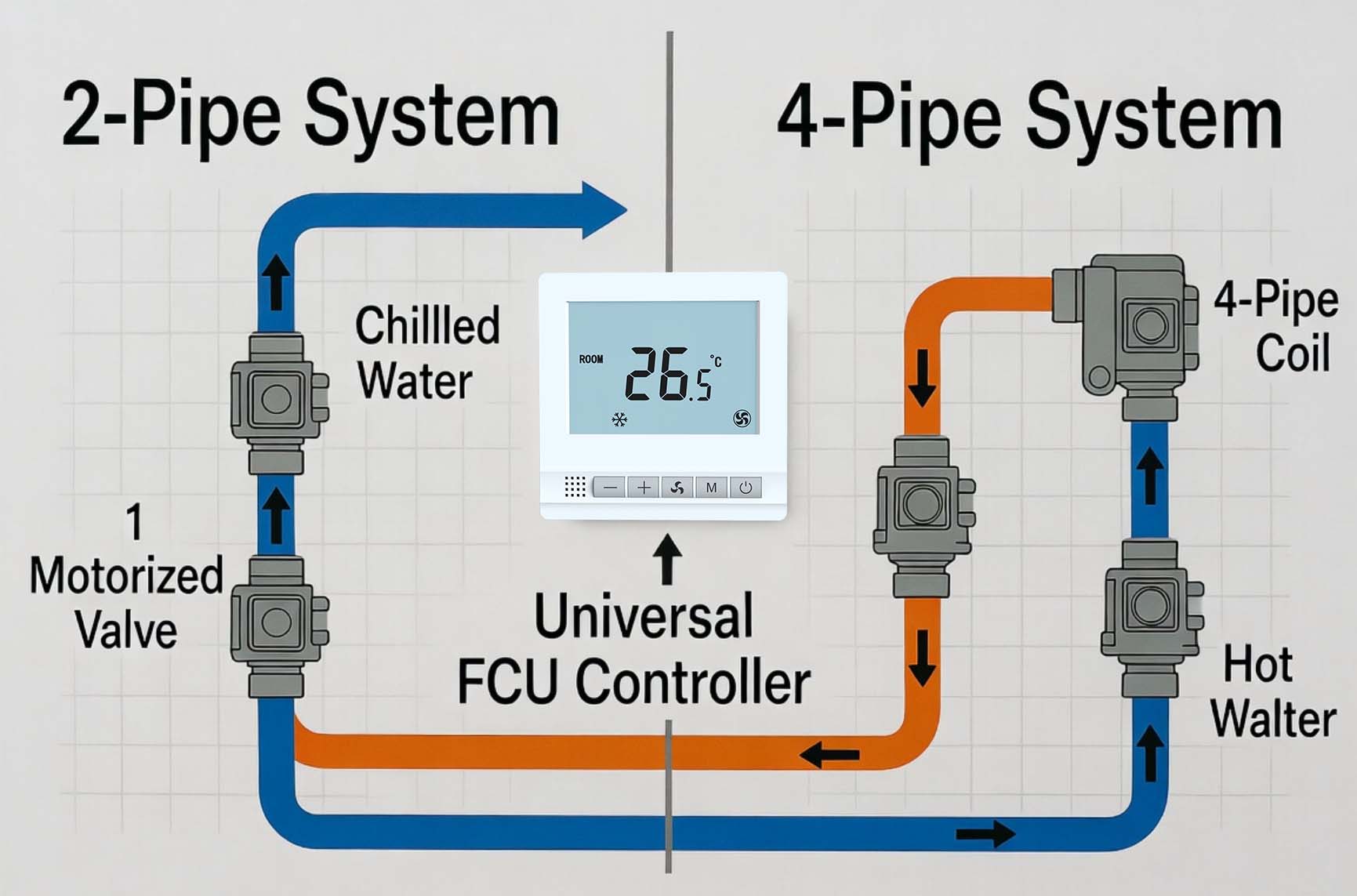
In today’s commercial HVAC and high-end multi-zone residential projects, energy efficiency is no longer optional—it’s a regulatory and financial necessity. Getting the thermostat wrong on a Fan Coil Unit (FCU) project is expensive. We often see bad controller choices leading to a massive 20-35% spike in energy use. Worse still? Constant temperature swings and a flood of guest complaints in hospitality settings. If you distribute HVAC parts, run an OEM brand, or integrate building systems, the controller you pick will absolutely make or break your bottom line. We put together this sourcing breakdown to show you exactly how modern FCU stats operate, the real-world differences between 2-pipe and 4-pipe setups, and the specific reason why 0-10V modulating EC fan control is aggressively taking over the market. 1. What is an FCU Thermostat & How Does It Actually Work? At its core, a Fan Coil Unit (FCU) thermostat isn't your average wall control. It’s a dedicated device built specifically to run the fan and the water valves inside a localized FCU. You simply can't slap a standard residential heat pump stat on the wall here. An FCU controller has to juggle two things at once: Airflow control: Managing fan speed (traditional 3-speed relays or 0-10V variable). Thermal flow control: Regulating motorized hot/chilled water valves. These systems are widely used in hotels, commercial offices, hospitals, and modern apartment buildings because they enable independent room-by-room climate control without relying on a massive central AHU (Air Handling Unit). 2. 2-Pipe vs 4-Pipe FCU Systems: The Core Differences Right out of the gate, your sourcing team needs to figure out system compatibility: 2-pipe or 4-pipe. Making the wrong call here stalls installations. Here is a fast, practical breakdown to help your engineers and buyers get it right: 2-Pipe FCU System 4-Pipe FCU System 1 supply + 1 return pipe 2 supply + 2 return pipes (hot & chilled) Seasonal switchover (entire building is on cooling or heating) Simultaneous heating & cooling available per room Controls 1 motorized valve Controls 2 independent valves Lower (less piping + simpler hardware) Higher upfront, but superior occupant comfort Budget residential, schools, warehouses Luxury hotels, premium offices, hospitals Moderate Excellent 💡 Pro Tip for Distributors: Stop stocking separate models. Go with a universal FCU stat—like our E-TOP FT-08 or FT-09. Installers can just toggle between 2-pipe and 4-pipe in the hidden setup menu. You cut your SKU count in half and lower inventory costs instantly. 3. The 0-10V Modulating Revolution: Why EC Fans Are Replacing Traditional AC Fans Traditional 3-speed AC fans are noisy, inefficient, and deliver only crude control. Modern projects are rapidly shifting to **EC (Electronically Commutated) motors** combined with 0-10V modulating control. Key Advantages of 0-10V Modulating Control: Massive Energy Savings: EC fans with 0-10V control typically deliver **30-50% lower energy consumption** compared to traditional 3-speed AC fans by running at optimal variable speeds instead of fixed high-energy states. Precision Temperature Control: Uses Proportional-Integral (PI) algorithms to dynamically adjust fan speed and valve opening (e.g., 12% speed or 45% valve open), completely eliminating the uncomfortable “hot/cold blast” effect. Dramatic Noise Reduction: Ideal for hotels and luxury residences—guests notice the whisper-quiet difference immediately. Extended Lifespan: Smoother, gradual operation means significantly less mechanical wear on motors and HVAC components. 4. E-TOP’s Engineering Edge: Future-Proof FCU Solutions As a global OEM/ODM specialist, E-TOP Controls delivers FCU thermostat solutions that meet stringent international building codes while offering robust customization for your brand. We don't just provide "one-size-fits-all" hardware—we provide a comprehensive ecosystem of control technology. Our diverse FCU thermostat portfolio spans across: Professional LCD Series: Reliable, cost-effective solutions featuring high-clarity LCD displays, perfect for large-scale commercial and residential projects where functionality is key. Premium Color Touchscreen Series: Featuring sleek 4.3-inch TFT displays and intuitive capacitive touch interfaces, these units add a high-end, luxury aesthetic to any modern building project. Flexible Integration: Our designs support a wide range of protocols including BACnet, Modbus, Zigbee, WiFi, and LoRaWAN, ensuring seamless connectivity with your existing BMS or smart home ecosystem. We make private labeling simple. Whether you need your brand logo on the interface, custom UI color themes to match your corporate identity, or unique wiring configurations for specific job-site requirements, we handle it all. Our engineering team provides deep technical support to ensure your integration team gets every FCU thermostat project installed correctly the first time, every time. 5. The Commercial FCU Thermostat Procurement Checklist Before signing off on your next major purchase order, run the specs through this exact checklist to avoid buying outdated tech: Supports both 2-pipe and 4-pipe modes (Universal firmware) 0-10V modulating output for EC fans and proportional valves Advanced PI (Proportional-Integral) control algorithm BACnet & Modbus compatible for flexible building system integration. Proven relay/valve durability for harsh commercial voltage environments Clear installer menu + mobile app/WiFi option Strong OEM/ODM customization capability directly from the factory Local technical support and solid warranty terms Ready to Future-Proof Your HVAC Projects? Selecting the right FCU thermostat—especially one equipped with 0-10V modulating control and true 2/4-pipe universality—is one of the highest-ROI decisions you can make in modern HVAC projects. Ready to future-proof your product lineup or project specifications? Contact the E-TOP Controls team today for product samples, technical datasheets, or customized OEM/ODM solutions. Our engineering experts are ready to help you select the optimal configuration for your market. -------------------------------------------------------------------------------------------------------------------------------------------------------------------- Technical FAQ (Optimized for HVAC Sourcing) Q1: What is the main difference between a standard HVAC thermostat and an FCU thermostat? A: A standard HVAC stat is built for unitary gear—think standard heat pumps or gas furnaces using basic G/Y/W terminal wiring. FCU thermostats, on the other hand, are engineered specifically to command multi-speed or variable fans and water valves at the same time. They feature built-in sequencing logic designed purely for commercial safety. Q2: How does a 0-10V modulating thermostat control fan speed? A: It outputs a continuous DC voltage signal (between 0-10V) using a PI control loop. The EC motor interprets this analog signal to run at any speed proportionally—delivering silent, precise, and highly efficient airflow. Q3: Can a 4-pipe FCU thermostat be used in a 2-pipe system? A: Absolutely. High-quality commercial models (like E-TOP’s series) allow installers to configure the device to 2-pipe mode via the software menu, which safely disables the unused valve output. This trick helps B2B distributors reduce stock SKUs dramatically. Q4: Are 0-10V FCU thermostats compatible with BMS systems? A: Yes, many advanced models support BACnet or Modbus RS485 protocols, making them ideal for large-scale Building Management System (BMS) integration in smart buildings. Q5: What is the typical ROI when upgrading to 0-10V EC fan control? A: Most commercial projects see a return on investment (ROI) within **18 to 30 months**, driven by massive energy savings and reduced mechanical maintenance costs.
View More