
Never miss an offer or update. You can unsubscribe at any time.
How to Connect a Wireless Boiler Thermostat: Technical Guide for Installers & OEM Partners
In the European heating market, field reliability is everything. For professional HVAC installers and OEM/ODM brands navigating various HVAC Thermostat Applications, a flaky wireless connection means costly callbacks and eroded margins. E-TOP’s 868MHz wireless room thermostats are built specifically to counter this, offering bulletproof RF stability and straightforward volt-free relay integration with major European boiler platforms.
Below is the technical walkthrough for wiring and commissioning our wireless receiver systems.
Before cracking open any casing, tick off these essentials:
The receiver is the nerve center bridging the boiler's PCB to the RF thermostat.
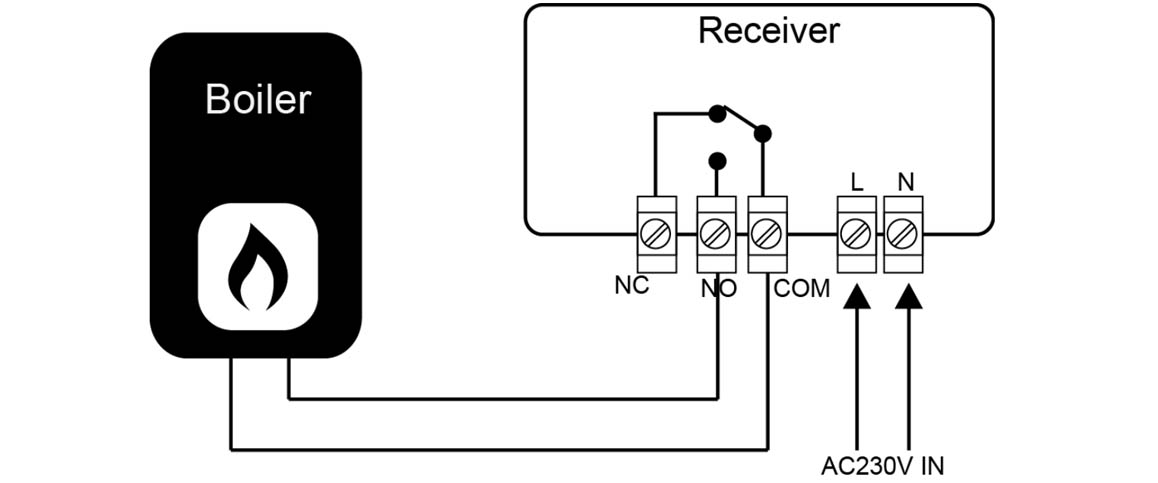
Crucial Safety Note: Double-check everything. Make absolutely sure that no stray 230V mains voltage is feeding back into a volt-free boiler PCB layout. E-TOP receivers use isolated switch contacts for a reason—to prevent expensive board blowouts on the boiler side.
We opt for the 868MHz frequency band for a simple reason: it cuts right through thick European brickwork where crowded 2.4GHz Wi-Fi channels fail completely.
Note: Want to speed up high-volume job rollouts? Most bulk E-TOP shipments land at your warehouse as pre-bound kits that sync automatically the second you power them up.
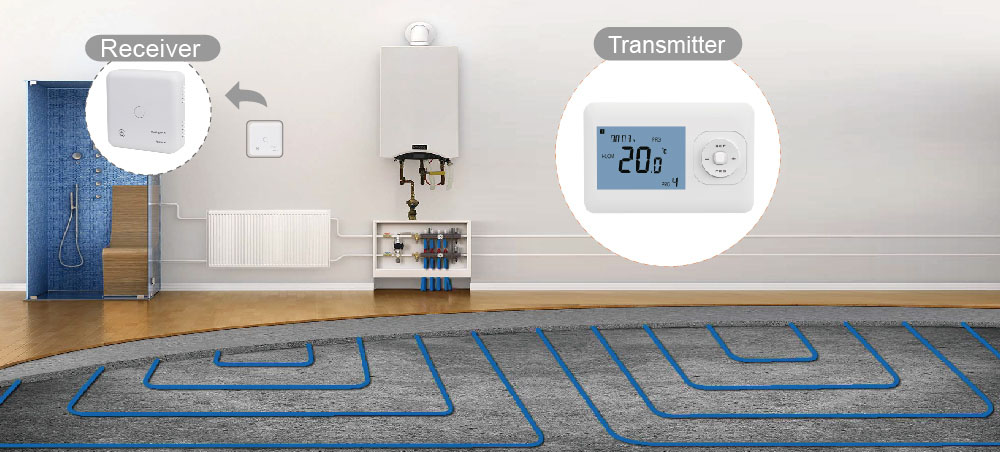
With over two decades of dedicated OEM/ODM manufacturing under our belt, we don’t just build thermostats—we engineer field-stable HVAC assets:
Tailored for B2B Operations: From custom firmware calibration and white-label housing to model-specific wiring documentation, we provide the engineering backbone your brand demands.

A: Think of COM (Common) as the input gateway where the signal enters from the boiler loop. NO (Normally Open) acts as a broken switch—the circuit stays wide open and the boiler stays completely dead until the thermostat demands heat, causing the relay to close. On the flip side, NC (Normally Closed) keeps the circuit closed by default. For the vast majority of standard European boiler installations, always stick to the COM and NO terminal pair. Wiring it this way ensures the system only fires up when the indoor temperature drops below your setpoint.
A: It all boils down to basic physics and wave penetration. The lower 868MHz frequency band punches through thick residential stone and masonry walls far better than high-frequency alternatives. More importantly, while 2.4GHz Wi-Fi channels are absolutely swamped with data traffic from domestic routers, streaming sticks, and smartphones, 868MHz remains a dedicated, quiet band reserved for low-power devices. This guarantees zero signal dropouts, drastically extends the thermostat’s battery lifespan, and secures a rock-solid link over long distances.
A: Absolutely. B2B white-labeling is our core business. As a dedicated OEM/ODM manufacturer, E-TOP doesn't just print your brand logo on the front. We can completely overhaul the receiver's physical housing, inject customized firmware to match your system parameters, and design bespoke wiring schematics tailored to your target boiler platforms (whether that's Ideal, Vaillant, or Bosch). Our in-house engineering squad supports your development team right from the initial prototype phase up to full mass production rollout.

 Address:No.6 of Tong'an Industrial Park, Meixi Rd,Tong'an District, Xiamen China 361100
 Phone:+86 0592 6155792
 Email:[email protected]